 Chicago
 Wheaton
Blog


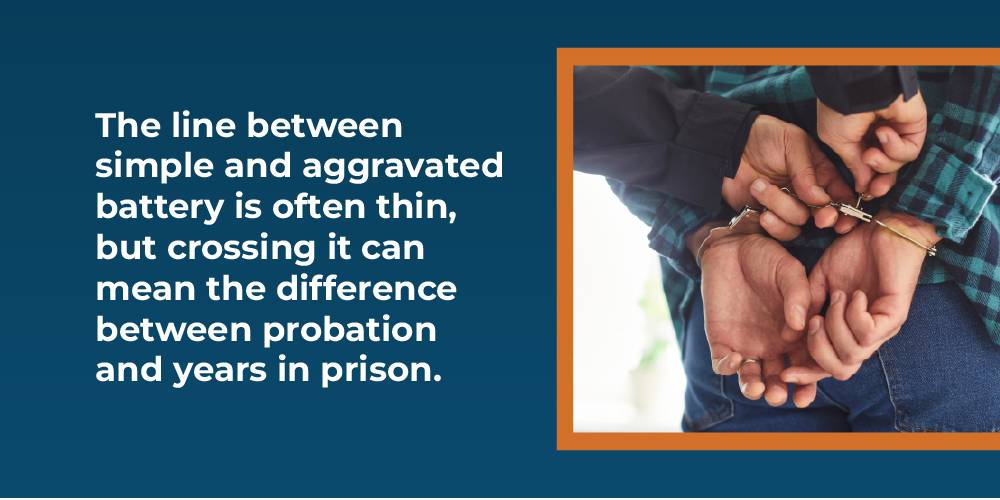
 Battery charges in Illinois can range from relatively minor offenses to felonies with severe penalties. The specific charge you face can mean the difference between probation and years in prison. If you are accused of battery, you need to understand how Illinois law defines these crimes and why the details of the case matter.
Simple battery and aggravated battery are two distinct categories of battery under Illinois law. Prosecutors decide which charge applies based on specific facts. To ensure you understand the charges against you and the possible defenses that apply to your case, speak with a Wheaton, IL battery defense lawyer as soon as possible.
Illinois law defines battery broadly, focusing on more than injuries. Under 720 ILCS 5/12-3, a person commits battery when they knowingly cause bodily harm to another person without a legal reason to justify it. Battery can also occur when someone knowingly makes physical contact that is insulting or provoking. This means an injury is not always required. Unwanted contact that is interpreted as insulting or provoking may still qualify.
For example, intentionally shoving someone during an argument may be considered battery under the right circumstances. Slapping a phone out of another person’s hand or grabbing someone’s arm to stop them from walking away may also qualify as battery. However, intent is a key part of the charge. The prosecution must show the act was done knowingly and not by accident.
Simple battery is the lesser of the battery charges, even though it is still a criminal charge. It often stems from arguments or physical confrontations. These cases depend heavily on witness statements and context. Small details can make a big difference in how the case is charged.
Simple battery is usually charged as a Class A misdemeanor in Illinois. It’s the most serious type of misdemeanor under state law, but it is still not as severe as a felony. A conviction can lead to jail time, financial penalties, or both.
You may face up to 364 days in jail and a fine of up to $2,500. In some cases, a judge may order probation or court supervision instead of jail, and these options often come with strict conditions. That may include counseling, anger management classes, community service, or limits on contact with the alleged victim.
Even when jail is avoided, a simple battery conviction can still have lasting effects. A criminal record is always a concern. One heated moment that does not define who you are can affect relationships, employment, housing, professional opportunities, and more.
Under 720 ILCS 5/12-3.05, a battery charge is considered aggravated when certain details make the incident more serious according to Illinois law. These factors go beyond basic physical contact or minor injury. They show that the situation involved greater harm, higher risk, or a person the law gives added protection to.
All it takes is one factor that can be considered aggravating for the prosecution to elevate a battery charge to a felony. The most common aggravating factors include:
Serious injuries
Strangulation or choking, even if it leaves no lasting injury
Use of a deadly weapon, including firearms or other dangerous objects
Battery against protected individuals
Battery against vulnerable individuals, including children, pregnant individuals, older adults, or people with disabilities
Certain locations or circumstances, such as incidents occurring in public places, schools, or correctional facilities
Because aggravated battery charges carry felony penalties, these factors are often closely examined and challenged during the defense process.
In the simplest terms, the law dictates that aggravated battery may apply when the injury goes beyond minor harm. Specifically, this may include broken bones or internal injuries. Permanent disability, meaning a lasting physical impairment, also counts. Any kind of disfigurement, such as scarring, would likely qualify as aggravated battery. Strangulation is automatically considered aggravated battery because of the danger associated with restricting airflow. Your attorney can review medical records and other evidence to determine whether the injuries truly meet this legal standard.
Illinois law increases penalties when certain individuals are involved. These people are protected because of their role or vulnerability. They include:
Police officers, firefighters, and emergency workers
Teachers, nurses, and certain public employees
Pregnant individuals, older adults, and children
People with physical or cognitive disabilities
For these enhanced charges to apply, the accused must have known or should have known the person’s status. This issue is often disputed in aggravated battery cases.
All aggravated battery charges are always felonies, but the level of felony depends on the facts of the case.
Aggravated battery charges may include any of these sentencing ranges under 730 ILCS 5/5-4.5:
Class 3 felony, with two to five years in prison
Class 2 felony, with three to seven years in prison
Class 1 felony, with four to 15 years in prison
Class X felony, with six to 30 years in prison
Class X felonies require prison time. Probation is not an option. However, these are usually cases that involve extreme circumstances, such as severe injury to a child or using a firearm in an altercation.
To convict someone of battery, prosecutors must prove every required element of the charge beyond a reasonable doubt. That’s the highest burden of proof. As previously noted, one of the most important elements is intent. Accidental contact or unintended actions generally do not meet this legal standard.
Prosecutors rely on several types of evidence. They may use witness statements, police reports, medical records, and photographs of injuries. In some cases, video footage or audio recordings are also used.
Many battery cases involve conflicting accounts of what occurred. Prosecutors may focus on consistency between statements and physical evidence. They could even try to use statements you made early in the investigation to prove intent. The outcome of a battery case often comes down to details and credibility, so a thorough review of the evidence matters.
There are ways to fight battery charges, and many cases depend on how the facts are interpreted. Lack of intent is obviously one of the most common defenses. Self-defense may also apply. In Illinois, you are allowed to use reasonable force to protect yourself if you believe you are about to be harmed. However, the response must match the level of the threat. Using more force than necessary can weaken this defense.
Battery cases often rely on witness statements, which may conflict or be unreliable. Physical evidence, medical records, or video footage may tell a different story. In aggravated battery cases, the defense may challenge whether injuries were truly serious or whether you knew the alleged victim had a protected status.
Battery charges can move quickly and carry severe penalties if you are convicted. Our Wheaton, IL battery defense lawyer can help protect your rights and challenge the prosecution’s case. Attorney Dion Davi is a former prosecutor, which gives him insight into how these cases are built and argued. If you are facing battery charges in DuPage County, contact Davi Law Group, LLC at 630-580-6373 to schedule a free consultation.
 A lawyer’s time and advice are his stock and trade.

 28371 Davis Parkway, Suite 103, Warrenville, IL 60555
 (630) 657-5052
 (888) 350-9195
1776 S. Naperville Road, Building A, Suite 105, Wheaton, IL 60189(630) 580-6373(888) 350-9195
321 N. Clark Street, Suite 900, Chicago, IL 60654(312) 985-5676(888) 350-9195
58 N. Chicago Street, Suite 102,(815) 582-4901(888) 350-9195
(888) 350-9195
1776 S. Naperville Road, Building A, Suite 105, Wheaton, IL 60189(630) 580-6373(888) 350-9195
321 N. Clark Street, Suite 900, Chicago, IL 60654(312) 985-5676(888) 350-9195
58 N. Chicago Street, Suite 102,(815) 582-4901(888) 350-9195



